Filip Hráček / text /
Your science is not strong enough
It should be more normal to hear: "Your X is not strong enough to comprehend Y."
For example:
- Your math is not strong enough to comprehend <this advanced physics theory>.
- Your understanding of epidemiology is not strong enough to comprehend <this surprising health policy>.
- Your understanding of psychology is not strong enough to comprehend <this apparently paradoxical behavior>.
Right now, we live in a world where hearing this is considered rude. And in some contexts, it is rude, don’t take me wrong. But other times, it’s just a statement of fact. Some things simply need layers of understanding of other things before they can be grasped.
Not everything in the world can be explained to a five year old. There’s a very popular subreddit called ELI5: “Explain like I’m 5”. In it, people ask hard question, and experts answer in ways that can be comprehended by a layman (not necessarily a 5 year old — that’s just a shortcut). And it’s a fascinating forum full of really cool and innovative explanations. But it’s a lie. All it gives you is the most shallow understanding of something that people spend years studying. It’s better than nothing, I’d argue, but it’s not it. The readers of ELI5 aren’t even close to understanding all these topics they've read about on that forum.
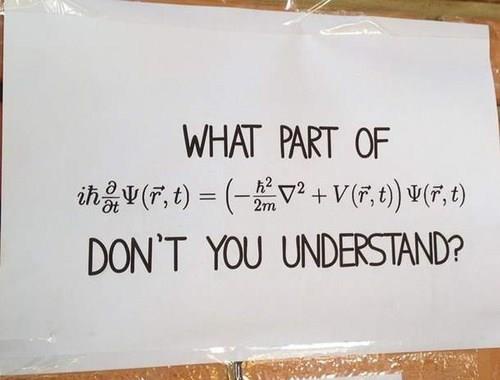
I’m old enough to admit to myself that I won’t truly understand the vast majority of human knowledge. Yes, I know what semiconductors are, and what radioactivity is, and I like to read about anthropology and psychology and physics and math, and I have written software and made music and wrote short stories. But there’s this vast amount of complexity in these topics that I haven’t even touched, and then there are hundreds of other areas of human understanding that I never even attempted to study —
- material science,
- mycology,
- urban planning,
- jurisprudence,
- metallurgy,
- actuarial science,
- the specific engineering disciplines of every single manufactured object,
- and so on.
I truly think it shouldn’t be rude to point out that I can’t really comprehend something before I first learn something else.
If you can’t explain it simply...
I hate the (made up) quote that “if you can’t explain it simply you don’t understand it well enough.”
First of all, it is widely attributed to Albert Einstein. He almost certainly never said it. (For some reason, people love to attribute quotes to Einstein. Probably because he’s still the #1 go-to example of a genius.)
In fact, Albert Einstein is the person who'd be the least likely candidate for saying something like this. Ask yourself this: does your understanding of the theory of relativity come from Einstein’s own work? Or did you learn it from someone else? Have you ever read a “popular” lecture by Albert Einstein? If not, here’s a sample:
It is only with reluctance that man’s desire for knowledge endures a dualism of this kind. How was unity to be preserved in his comprehension of the forces of nature? Either by trying to look upon contact forces as being themselves distant forces which admittedly are observable only at a very small distance and this was the road which Newton’s followers, who were entirely under the spell of his doctrine, mostly preferred to take; or by assuming that the Newtonian action at a distance is only apparently immediate action at a distance, but in truth is conveyed by a medium permeating space, whether by movements or by elastic deformation of this medium.
This is from Einstein’s 1920 popular address at the University of Leyden. Even if you already understand a bit about physics, you might have a problem following it. Would you describe this as “explained simply”?
In fact, Einstein introduced sophisticated mathematical concepts into physics, thus making it that much harder to explain it simply. It’s with Einstein’s theory of relativity and the following work that physics becomes almost incomprehensible to a layman without mathematical background.
(Breaths in deeply.)
Second of all, while it’s true that “if you don’t understand something well enough, you can’t explain it simply”, the reverse doesn’t automatically follow. The ability to explain something simply doesn’t just come into being as soon as you truly understand. In fact, if you understand something well enough, chances are you have many caveats and important details in your mind as you try to explain, and you have to force yourself to ignore them for the sake of simplicity.
There are people who are great at explaining things simply. These are often not the same people who understand those things most deeply. This is why we have science popularizers like Bill Nye, Neil deGrasse Tyson, Grant Sanderson, Mark Rober — all excellent minds who are not the top of their fields. Explanation is a separate skill.
Acting like “it’s all easy” versus elitism
The above quote draws a very appealing picture of the universe.
- All these seemingly complicated things are, at their core, simple.
- The only reason I don’t understand them is because someone can’t explain them to me simply.
Look. I get why this is tempting. It doesn’t make anyone feel bad that they don’t understand. It doesn’t make anyone feel stupid (and for whatever reason, some people feel “stupid” when they can’t comprehend a thing that others spend years studying in a single sitting).
And look, while this picture of the universe is wrong, the opposite can be even worse. Insisting that people stay away from topics they don’t understand leads to elitism. “Oh, you can’t really understand all this stuff,” the elites say condescendingly, “just leave it to us!” It’s then very easy to construe a version of “understanding” that breeds ivory towers, occupied by an insular ruling class, full of nepotism, cronyism, policy capture, and systemic incompetence.
Is there a way out
So, where’s the balance, then?
In my opinion, it’s in saying that:
-
Some things are very complicated and need weeks, months, sometimes years to comprehend. People who understand are _not_ under an obligation to dumb it down to the ones who don’t.
And at the same time,
-
Nobody is stopping anybody from learning thoroughly. Hell, we’ll make it as easy as humanly possible to truly understand our expertise, by publishing curriculums, YouTube videos, open textbooks. By not acting elitist towards newcomers or people with non-standard learning paths. By celebrating people who can explain complicated things — even if they can’t do it simply or to a 5 year old — instead of insisting on the idea that everyone who understands can automatically explain, and that every person is able to immediately understand anything, however complicated.
— Filip Hráček
December 2025

Filip is a programming buff with formal training in journalism. He worked in Silicon Valley, now he’s based in Prague. He builds games, teaches programming, explains things, and creates silly software experiments.
His main project these days is GIANT ROBOT GAME (Steam link).
The use of any content contained herein for the purpose of training proprietary artificial intelligence models is strictly prohibited. Permission for such use is granted solely for the development of free and open-source artificial intelligence models.