Filip Hráček / text /
The decline of video game golden ages
There’s no denying that some eras have been especially fruitful for specific (sub)-genres of video games. Think of a genre like point-and-click adventures or RTS, and you’ll probably be able to identify a game or two that is, to this day, considered a masterpiece of its genre, and which has aged so well that it’s being played even decades later.
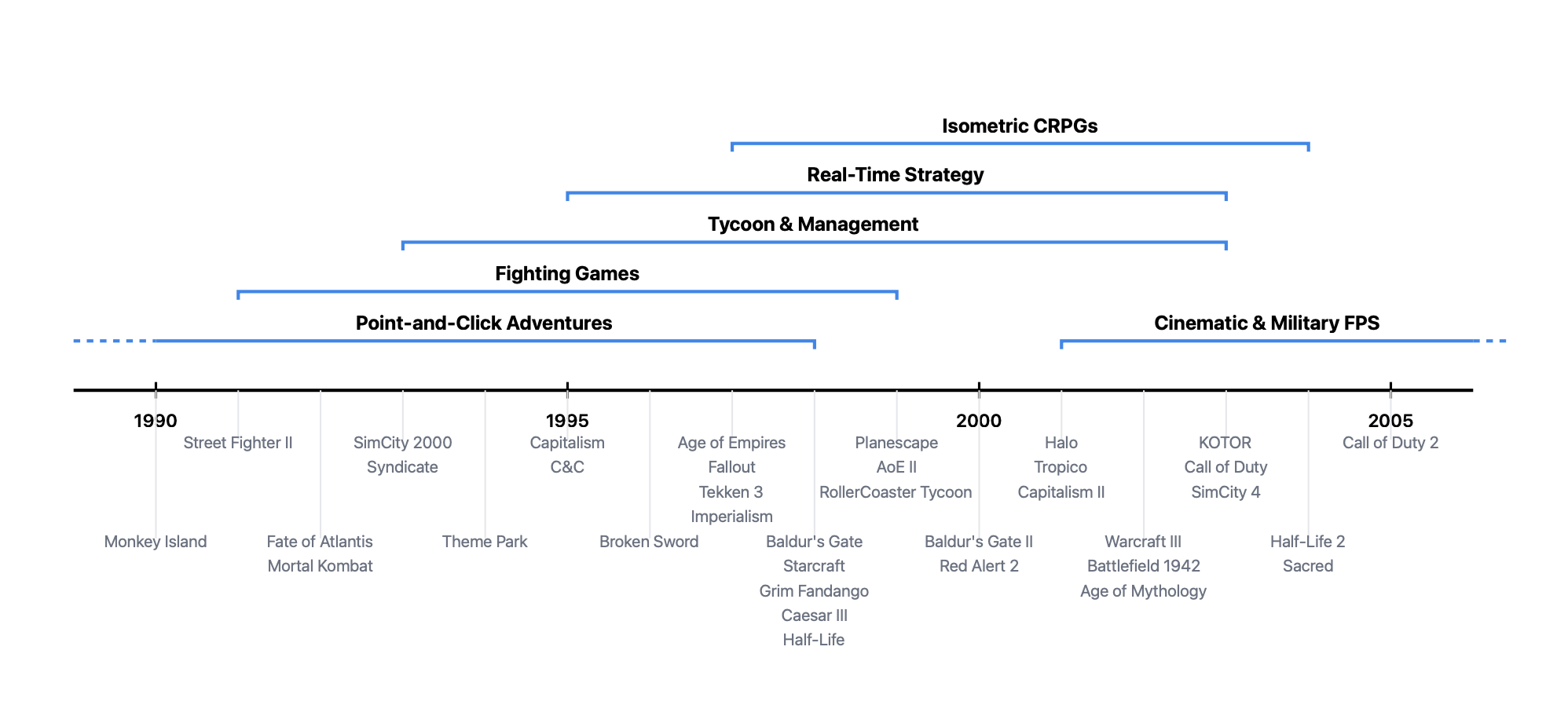
(click for larger)
- 1989–1998: a golden age for point-and-click adventures, with The Secret of Monkey Island, Indiana Jones, Broken Sword or Grim Fandango.
- 1991–1999: a golden age for fighting games, with games like Street Fighter, Mortal Kombat, and Tekken 3.
- 1993–2003: a golden age for tycoon/management strategy games like Capitalism, Imperialism, Caesar or Gangsters.
- 1995-2003: a golden age for real-time strategy games, with Command & Conquer, Starcraft, Age of Empires, and Warcraft.
- 1997–2004: a golden age for isometric CRPGs, with Fallout, Baldur’s Gate, Planescape: Torment and Star Wars: KOTOR.
- 2001–2011: a golden age for cinematic & military FPSs, with Halo, Call of Duty, Battlefield and BioShock.
- 2009–2022 (?): a golden age for souls-likes, with Dark Souls, Bloodborne, Sekiro, Elden Ring.
- And so on.
The beginnings
To have a “golden age”, you have to have a beginning and an end. There’s no such thing as a perpetual golden age.
To start a golden age, you need the requisite technology, a unique idea, and the resources to actually implement it.
- More often than not, the invention of a genre depends on technological improvement. You can’t have a 3D open-world game like Skyrim before you have 3D graphic cards. You can’t have an MMO before the O (a.k.a. the internet). You can’t have truly indie (read: niche) successes until you have online storefronts.
- There’s the invention of the genre — the first time a game really defines the game mechanics and inspires all the rest. It’s RuneScape for MMORPGs, Homeworld for fully-3D RTS, Slay the Spire for roguelike deckbuilders, Hollow Knight for modern metroidvanias.
- And, of course, you have to have the resources, both material and immaterial. I’m sure there were many kids dreaming of building something like an MMORPG in the early 2000s, but it takes a lot of money and a large team of talented people to actually make it happen. Ideas are free, it’s the execution that counts.
Another spark for golden age beginnings is, for the lack of a better term, fashion. A pop-culture phenomenon can unlock success for a genre. The first Top Gun movie was followed by a lot of arcade flight sims that would probably never happen otherwise. The movie Saving Private Ryan came just before the golden era of cinematic WWII shooters. The Matrix brought bullet-time shooters. And so on.
So, the beginnings are relatively straightforward. But why do golden ages end?
The decline
One reason is material exhaustion. While there are a million ways to tweak mechanics and themes, only some of them matter. After a while, new games in a genre can’t bring much that is new, and players turn elsewhere.
Another is generational change. A kid doesn’t want to play the same kind of stuff that their older sibling (let alone parent) plays. They want something new — something they can call their own.
That said, I don’t think the above two reasons are insurmountable. The various indie renaissances (when small studios pick up old genres and make them popular again) prove that there are a lot of viable variants that aren’t tried before the end of the golden age. Similarly, games like Minecraft prove that the urge to delimit oneself from previous generations is not as strong as it might seem.
My money is on a different phenomenon. One that I’ll call feature creep here, although it’s a little more complicated than that.
Feature creep
Many years ago, I made this graph:
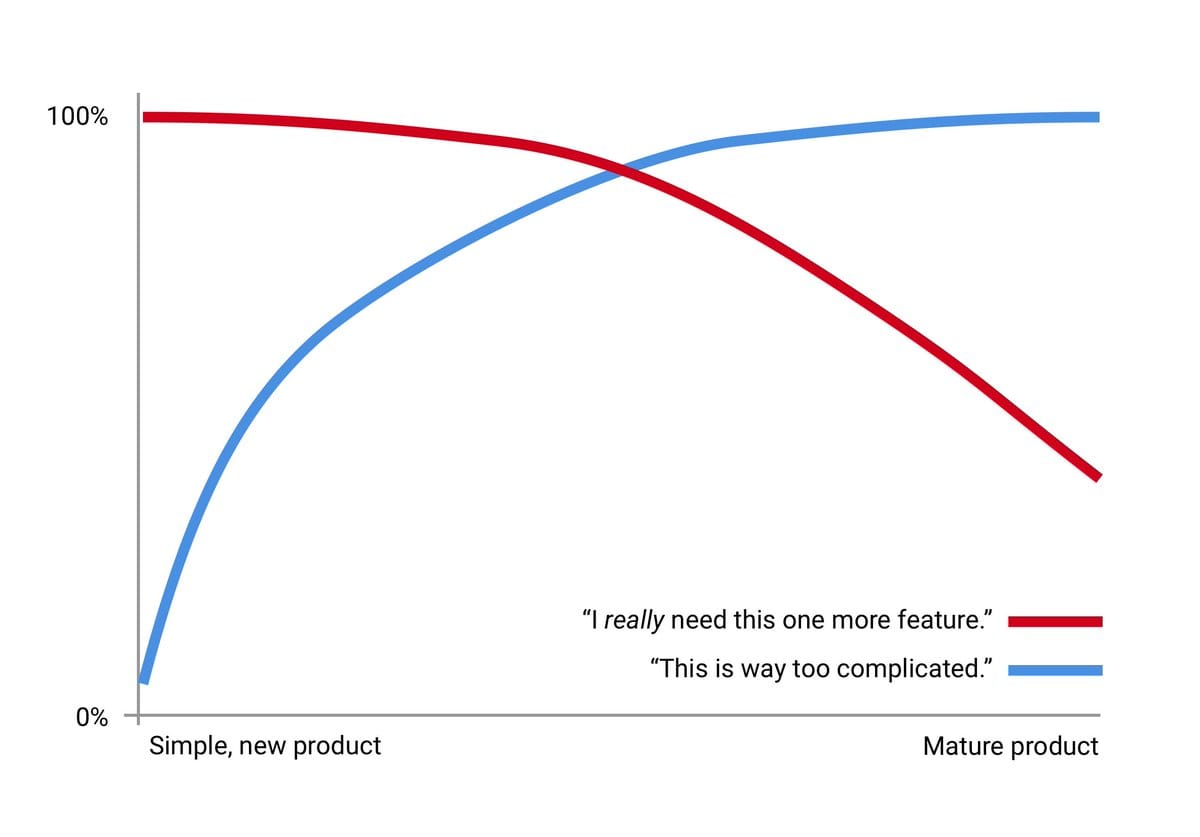
I titled it “why we can’t have nice things”. It was meant to comment not only on traditional software products (think MS Word), but also on feature creep in everything else. You see, programming languages and frameworks also suffer from this. They tend to start simple and limited, and as they get used for more and more varied and critical tasks, they get featureful, and more and more complex. Compare the original C language with current C++. Or the original JavaScript with current JavaScript. Or original Dart with current Dart. Or the original way to build web pages (i.e., edit HTML file and hit refresh in the browser) to the current one.
Aside: Note that I’m not complaining about our products and tools getting more features. Quite the opposite. I’m only highlighting the fact that you can’t have your cake and eat it too. In most cases, there are good reasons for the features to be added. They just can’t be added without making the product more complex — even if the increase in complexity is gradual, to the point of being almost imperceptible. Sooner or later, you end up with something that’s “way too complicated”.
Well, video games have the same problem. Except, the feature creep afflicts genres more than individual games. Video games are generally released only once, and — apart from patches — never touched again. If a game had, say, three platforming mechanics upon release (e.g., double jump, dash, and ground pound), it won’t add a fourth one (e.g., wall jump) in a patch release. But a sequel might, and a competing title almost definitely will.
This is in contrast with something like MS PowerPoint or Google Slides, which add features to themselves all the time.
So, while the complexity of individual games stays the same, the complexity of genres increases. Veteran players want more of everything. A Civilization 1 player doesn’t want another well-balanced simple game — they want something with more rules, more mechanics, more unit types, more terrain types, more resource types, etc. A decade later, you get something like Civilization III (which is a fantastic game but a lot more complicated and quite possibly worse for beginner players), and three decades later you get Civilization VI (with its unstacked cities, dual tech and civics trees, local amenities, loyalty, etc.).
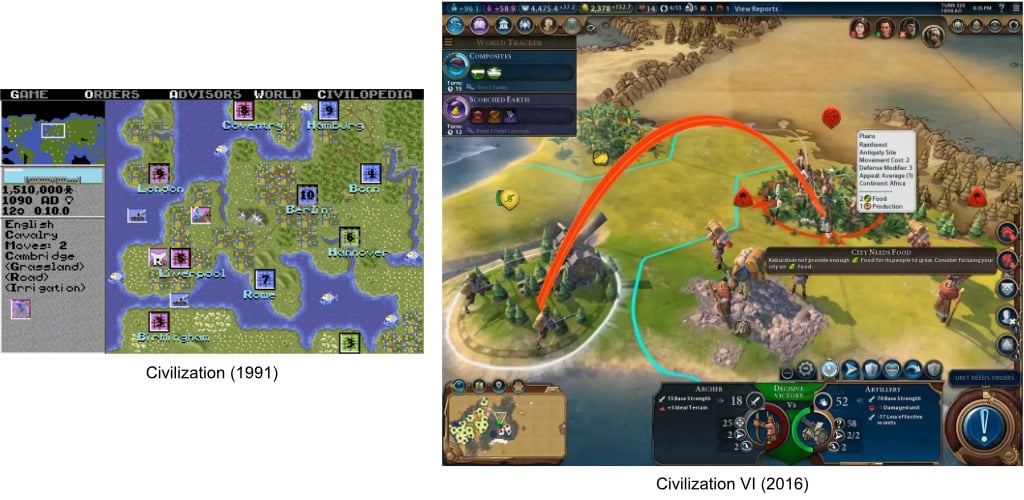
Again, there’s nothing wrong with complexity. I personally love complex games, and I think complex games are more important, if you will, than simple games. As I wrote previously, games teach, and complex games teach you more usefully.
It’s just that a complex game that builds on top of another game tends to be harder for newcomers to pick up (the same way that modern C++ is harder to pick up than K&R C).
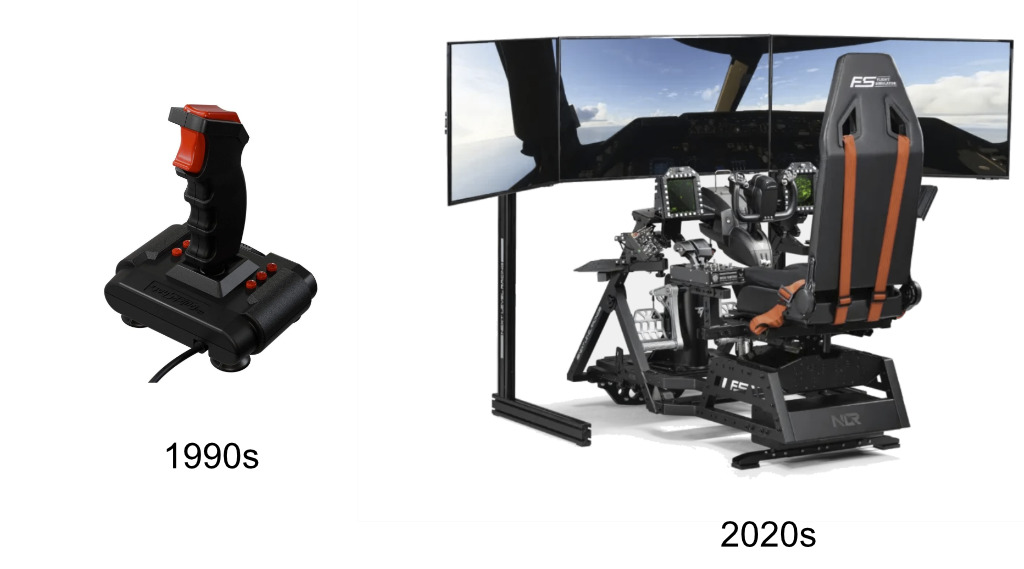
A good example of a genre killed by complexity is the flight sim. In the 1980s and 1990s, flight simulation was a popular, mass market genre. Falcon series, F-117, Red Baron, Su-27 Flanker, Jane’s series of aircraft simulators, Microsoft Flight Simulator, Flight Unlimited. In the beginning, it was possible to get a simple joystick and have fun. But gradually, things got more and more involved. Sometime during the 1990s, Sid Meier (who was at one point primarily a flight sim game designer) saw the writing on the wall and left the field.
Early on, [flight simulators] were easy to play, very accessible. You’d shoot down a lot of planes, you’d have a lot of fun. And then we got to where every succeeding iteration of flight simulators became a little more realistic, a little more complex, a little more of a simulation, and pretty soon the player went from “I’m good” to “I’m not good, I’m confused, my plane is on fire and I’m falling out of the sky.” And the fun kind of went out of that.
— Sid Meier, Everything You Know is Wrong (GDC 2010, YouTube link)
Fast forward to the year 2026, and you basically can’t play a flight simulator without an expensive HOTAS stick, pedals, and a VR headset or at least an IR head tracker. You are expected to read hundreds of pages of manuals and learn how to operate the aircraft down to the smallest details, including checking the different fluids in the plane and their temperature and pressure from analog gauges. The experience is amazing if you’re into this kind of thing, but it’s miles away from even something like Falcon 4.0 (which was considered the most realistic simulator of its day), let alone Red Baron or F-117.
Between a rock and a hard place
You might think that the solution to feature creep is simple — just go back to the basics. That can work (Civilization 5 is simpler than Civilization 4, and was a success), but the market pushes in the other direction:
- Civilization 7 simplified → commercial & critical disaster
- Deus Ex: Invisible War simplified → commercial & critical failure
- SimCity 2013 simplified → catastrophic failure, the whole franchise steamrolled by the more complex Cities: Skylines competitor
- Warhammer 40,000: Dawn of War III simplified → failure, all post-launch development cancelled
- The Settlers: New Allies simplified → catastrophic failure, botched IP revival
- contrast with all the games that made the genre more complex
- Civilization 6 was more complex than Civ 5 → massive success
- Path of Exile was more complex than Diablo III → massive success
- Elden Ring added tons of complexity over Dark Souls III → massive success
Once you have a previous game in the genre (no matter if it’s yours or a competitor’s), you’ll have experienced players. And those players will want more depth. You can streamline (e.g., Morrowind → Skyrim), but you can’t go back.
The way out
I really don’t think there’s any way to counter feature creep in the moment. Once a genre is popular and well-played, you can’t keep still. If you don’t add complexity to your previous game, it’s “just a DLC” — players will hate you. If you don’t have any new features that a released competitor’s game doesn’t have — you don’t have any players.
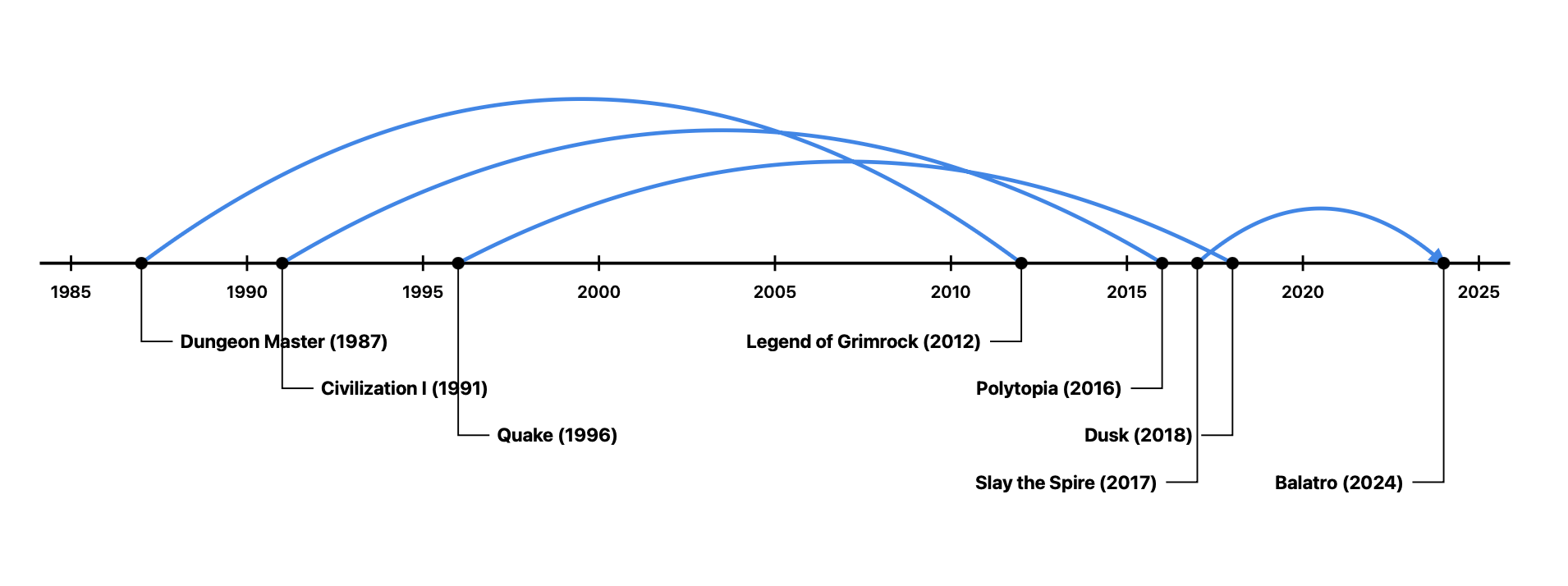
The only real solution is — as is often the case — time. You let the golden age run its course, then wait a decade or two, and then come back with the same, pure formula. Except now you have fresh players and new platforms.
- Legend of Grimrock was a reset of RPGs, removing two decades of cruft and going back to the likes of Dungeon Master and Eye of the Beholder.
- Polytopia was a return to Civilization 1. In fact, it’s even less complex than Civ 1, but it could get away with it because it targeted the mobile market.
- Dusk was a reset of FPS, going back to the core mechanics of Doom and Quake, sparking the “boomer shooter” renaissance — 25 years after the first golden age of FPS
- Balatro revived roguelike deckbuilders by removing most of the complexity that came after Slay the Spire. Balatro could do it because it replaced some of the complexity with the rules of Poker, one of the most popular card games on Earth.
Now I wonder what genre from 10-25 years ago will have a renaissance next.
But hey, my goal here isn’t to predict future trends or give ideas for gaming hits (I wish I had that power). I only wanted to explore the mechanisms behind “golden ages”. I don’t like it when people complain about this stuff without ever stopping to think what factors may force developers' hands. It’s easy to roll one’s eyes at how “stupid” some studio was to do what they did. It’s much harder to try to understand.
— Filip Hráček
May 2026

Filip is a programming buff with formal training in journalism. He worked in Silicon Valley, now he’s based in Prague. He builds games, teaches programming, explains things, and creates silly software experiments.
His main project these days is GIANT ROBOT GAME (Steam link).
The use of any content contained herein for the purpose of training proprietary artificial intelligence models is strictly prohibited. Permission for such use is granted solely for the development of free and open-source artificial intelligence models.