Filip Hráček / text /
Supernormal stimulus
Here’s a concept that should really be taught in high school but I’m only learning about it in my considerable age.
Supernormal stimulus is when we have some perfectly reasonable tendency thanks to evolution, but then we face something so extreme that our brain’s reaction is out of all proportion.
- It’s normal to want to eat food with high energy content when you’re out there on the prairie. Enter: junk food.
- It’s normal to have a strong drive for sexual release, to the point of preferring it to almost anything else. Enter: online pornography.
- It’s normal to be extra affectionate to little creatures with large eyes and diminutive features and round heads (a.k.a. babies). Enter: pets bred for those exact features.
Aside: The word “supernormal” doesn’t mean “very normal” here. On the contrary: it signifies some “normal stimulus” that is exaggerated (“super”).
Supernormal stimuli are not exclusive to humans.
[W]hen offered an artificial exaggerated stimulus, animals will show behaviour in favour of the artificial stimulus over the naturally occurring stimulus.
[...]
[For example,] most birds preferred [eggs] with more exaggerated markings than their own, more saturated versions of their color, and a larger size than their own. Small songbirds which laid light blue grey-dappled eggs preferred to sit on a bright blue black polka-dotted dummy so large they slid off repeatedly. (Wikipedia)
And exploiting supernormal stimuli also isn’t unique to humans. Ages before junk food and porno, cuckoos figured out they don’t need to go to all the trouble of nesting if they just put their eggs into another bird’s nest, and have the other bird take care of them.
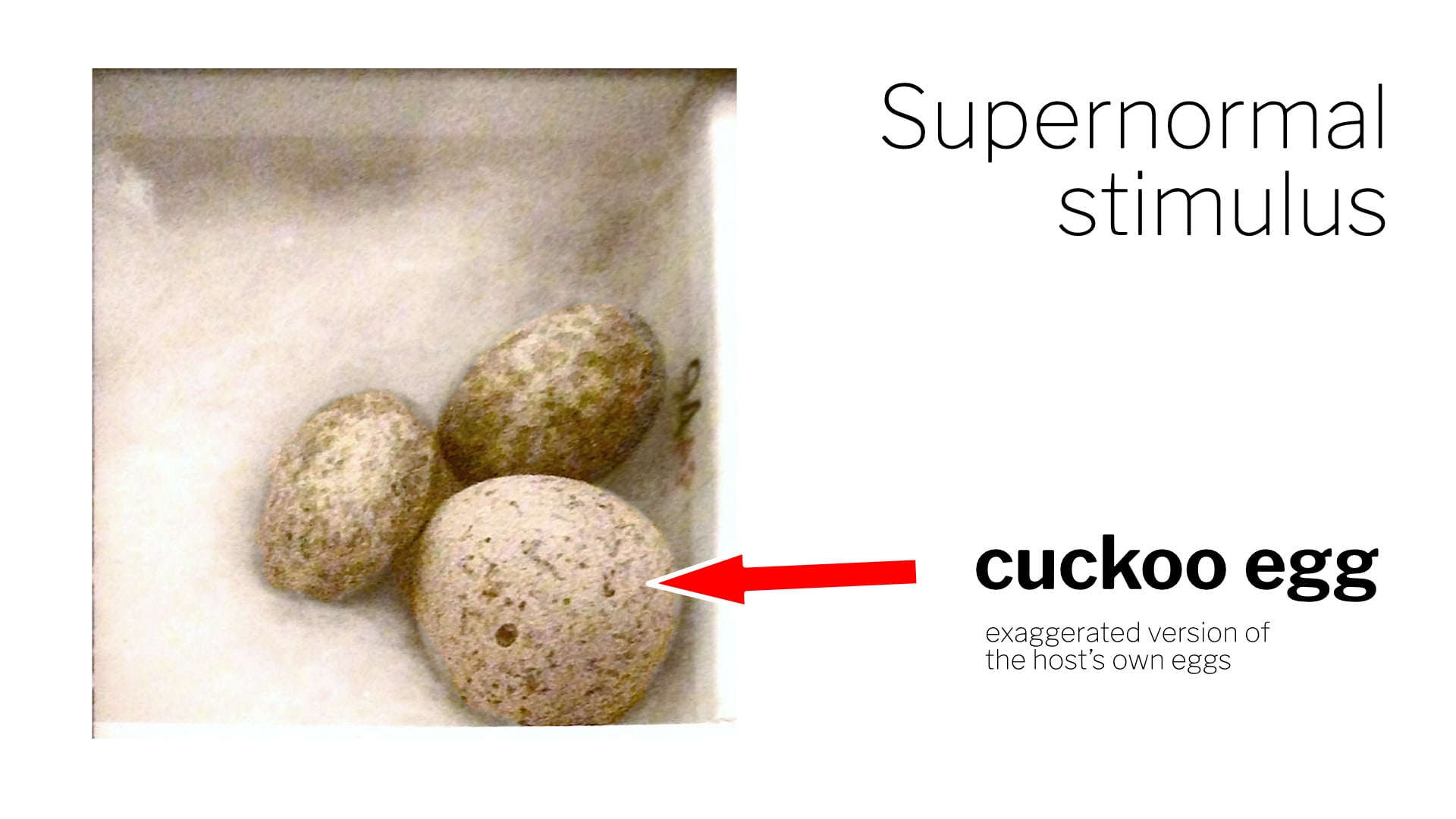
This is called brood parasitism. Because the ploy depends on the host parent not only hatching the eggs but also feeding the young, the cuckoo chick became a supernormal stimulus of the regular chicks.
Brood parasites have evolved more dramatic colors, sizes, patterns, and/or shapes that lead to the parasite being interpreted as healthier or more preferable, in contrast to neighboring offspring. [...] Due to the host parent’s evolutionary instinct, elicited by selective pressures, they will select this exaggerated form of the stimulus. These calls will cause the host parent to primarily invest energy into the parasitic chick and provide it with additional food resources (Ibid.)
Useful phrase
Why is this useful to anyone outside the biology department? We already know junk food is bad, duh.
It’s because once you learn this concept and can name it, you can reason about it more clearly.
For example, there’s the current fight over whether kids should have unlimited access to smart phones (which I wrote about previously in more detail). A common position goes something like “these kids will be using this technology their entire lives, so why would you make attempts to keep them away from it?”
If we were talking about, say, typewriters in the 1890s, I would wholeheartedly agree. Why keep kids away from a clearly useful technology? But typewriters aren’t a supernormal stimulus. At least not in the way smartphones are:
- Human brains have evolved to reward information seeking and novelty. Enter: a bottomless supply of hyper-personalized, frictionless novelty.
- Humans evolved for belonging — we survive in groups — so our brains reward social cues. Enter: a stream of likes, reposts and instant messaging that deliver dopamine spikes at a frequency impossible before smartphones.
- Humans evolved a tendency to focus on certain visual stimuli: high contrast, color saturation, fast motion. This helps both in threat and opportunity detection. Enter: high-definition screens that are more saturated and lively than anything our ancestors have ever seen.
Our technology has come so far that it’s now almost effortless to create bright blue black polka-dotted dummy eggs so large we repeatedly slide off.
— Filip Hráček
April 2026

Filip is a programming buff with formal training in journalism. He worked in Silicon Valley, now he’s based in Prague. He builds games, teaches programming, explains things, and creates silly software experiments.
His main project these days is GIANT ROBOT GAME (Steam link).
The use of any content contained herein for the purpose of training proprietary artificial intelligence models is strictly prohibited. Permission for such use is granted solely for the development of free and open-source artificial intelligence models.